
The Gujarat government will provide an assistance of Rs 1500 million to Amul cooperatives to help them export milk powder.
The government will provide Rs 50 for every kilogram of milk powder exported.
As we have described in detail about the tight condition of Amul recently in our blog. Also, we have discussed on the situation of year 2018 with current market situation in detail with series of events.
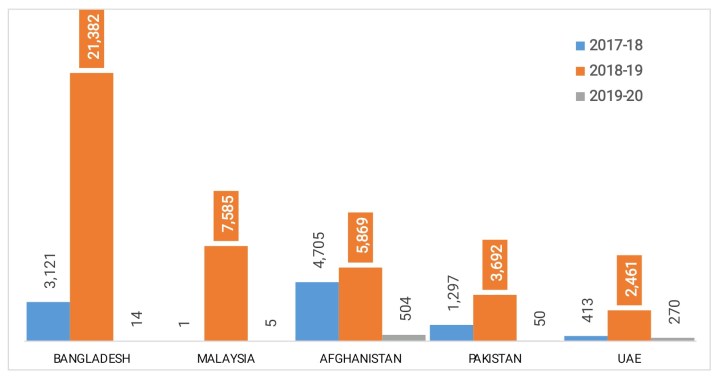
In year 2018, the Gujarat government has provided similar support to export the surplus milk powder. With the help of export subsidy, India could able to export about 50 thousand tonnes of SMP in 2018-19. Of this 85% was exported to neighbouring countries (Bangladesh, Malaysia, Afghanistan, Pakistan and UAE).
What this new Rs 1500 million export subsidy mean?
- With Rs 50 per kg subsidy to export the milk powder and Rs 1500 million cap, it will help to clear about 30,000 MT.
- As in year 2018, the main export destinations were neighbouring countries. The target destinations will remain same this time too.
- In year 2018, export subsidy helped to clear the stock which piled up during the flush months of the season. In the current situation, it will help to ease the stock mounted during the lean months.
- The export of milk powders during Apr-Jul 2020 was just about 1,300 MT which would increase exponentially in coming months.
- The current subsidy won’t make much change in the stock position as India is approaching the flush season of milk production.
- If the milk procurement by the Amul will increase by 10-15% in the flush season from the current level of 20 million litres per day and milk sale will remain at same level of 16-17 million litres per day, this will widen the gap further and force to convert surplus quantity into commodities which will again needs to clear.
- The coming flush season will create huge pressure on the producer prices if the stock position won’t show any improvement.
- The subsidy by Gujarat government to Amul will create pressure on other state governments to follow the similar step to handle the situation.
- The international price of SMP as per the latest GDT auction is Rs 200-220 per kg. With Rs 50 per kg subsidy will provide enough edge to Indian SMP in international market.
- The neighbouring countries are mainly dependent on New Zealand to meet their local demand, the low priced SMP from India may create mild turbulences for New Zealand’s SMP.
- Gujarat cooperatives are also procuring milk from not only in Gujarat but also from Uttar Pradesh, Rajasthan, Madhya Pradesh, Punjab, Bihar, West Bengal, Assam and Maharashtra states. With this subsidy, producers from other than Gujarat will also be beneficial and make the regional cooperatives less competitive in the their market.
- How long this subsidy infused export of the dairy commodities will sustain? It started in year 2018 and followed again in year 2020. It is creating a precedence that India’s powder price cannot be at par with the international market rate.
- After the export subsidy in the year 2018, the powder price started moving in north side steadily and touched the rate of Rs 300 per kg. This shows despite largest milk producer in the World, how the Indian Dairy Market is sensitive to small trade volume.
- The international price of powder will remain sideways/negative from current level as the flush season has already started in the Oceania region which is the largest exporter of powder and having better milk production levels compared to previous year.
Now it’s interesting to see how the rest of the events will take shape in near future.
 Dairy Market Outlook